
PWM Edition
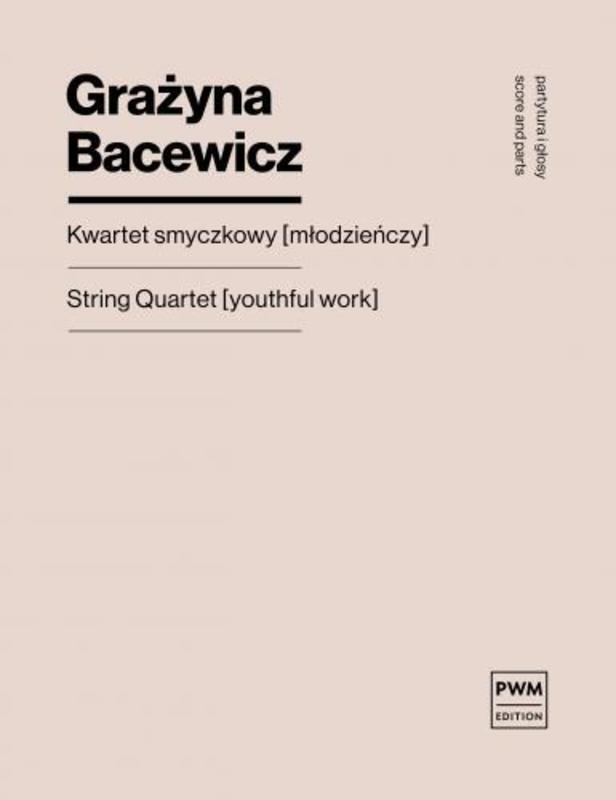
Bacewicz - String Quartet (Youthful Work) Score/Parts
Regular price
$115.00
Regular price
Sale price
$115.00
Includes GST
Sold out right now. We may be able to order it in. Call or message us and we’ll check with the supplier.
Standard shipping $7
Ships once we’ve sourced it. We’ll confirm exact timing with you first.
Free over $150.
Express shipping $15
1–3 business days depending on location.
Flat rate Australia-wide. Choose Express at checkout.
Click & Collect Free
From our Footscray showroom
Quantity
Couldn't load pickup availability
In stock now in String Ensemble
-
Schott Music
Chanson de Martin: 20th Century Pieces for String Quartet by John Kember, Schott Music, 64 Pages
Regular price $64.95Regular price -
Flying Strings
Pick A Part Set Of 4 Pieces For String Ensemble Sc/Pts (Flying Strings)
Regular price $69.95Regular price -
G. Henle Verlag
Zemlinsky - String Quartet No 3 Op 19 Stdy Score (G. Henle Verlag)
Regular price $67.95Regular price -
G. Henle Verlag
Zemlinsky - String Quartet No 3 Op 19 Set Of Parts (G. Henle Verlag)
Regular price $153.00Regular price


Make 4 interest-free payments of $28.75 with Afterpay
or pay nothing today with Zip
Delivery & collection
Standard shipping $7
Ships once we’ve sourced it. We’ll confirm exact timing with you first.
Free over $150.
Express shipping $15
1–3 business days depending on location.
Flat rate Australia-wide. Choose Express at checkout.
Click & Collect Free
From our Footscray showroom
- 4.6 from 927+ Google reviews of Scarlett Music (opens in a new tab)
- Returns & warranty
- Price-match promise
- Authorised PWM Edition dealer
Not sure it’s the right one? Talk to a player.
View full detailsDescription
SKU PWM12637
Grazyna Bacewicz realised at a very early age that her main purpose in life was to compose music. Already during the 1920s, as a student of Lodz Conservatoire, as part of her lessons in harmony and counterpoint, she made attempts at composing, in which she tried to resolve nagging technical problems and impart an artistically satisfying form to them. She grew up in an atmosphere of anti-romantic tumult and the emerging neoclassical style. She assimilated the main attributes of that current in a natural way: the need to forge logical formal constructs based on new harmonic principles, not determined by the major-minor system, and also a freedom in the shaping of textures, a fixed element of which was the combining of homophony with more or less strict polyphonic forms.
One example of such a strategy is the String Quartet from her student years, signed with the date 1929-1930, which the composer did not include in her official catalogue of works. In the first movement (Allegro moderato), one can distinguish two principal subjects, served in the form of the incomplete exposition of a fugue. The chromaticised first subject, with its strongly highlighted head motif, appears in the cello, with an answer coming four bars later in the first violin. After a short bridge, the first violin intones the second subject, of a different character (dolce), and the answer appears a bar later and an octave lower in the viola. Both subjects can be heard also in the closing coda, and the space between them is filled by counterpoints based largely on ostinato figures of various sorts - a technique that Bacewicz would hone to perfection in her later work.
The middle fughetta (Molto adagio), with a subject stated just once, and in only three parts (cello, first violin, viola), acts as an intermezzo.
The third movement (Allegro molto moderato) is a double fugue with strongly contrasting subjects. The first subject, in the form of a chromaticised melodic continuum, exposed by the cello, is initially shown with the traditional arrangement retained (answered by the viola and second violin at a fifth, and by the first violin an octave above). The second subject (energico) is a structure shaped by the opening repetition of a motif of perfect fifths, then octaves combined with staccato-tremolo figurations. As the work unfolds, the two subjects appear simultaneously in original and inverted form, coming together in the closing Cadenza in a uniform idea crowned by strong (fff) chords repeated towards the end.
Malgorzata Gasiorowska
Details & dimensions
- Brand
- PWM Edition
- Type
- String Ensemble
- Composer
- Grazyna Bacewicz
- Catalogue no.
- PWM12637
More like this
-
Australian Wind Music Publications
66 Great Tunes for Clarinet BK/CD
Regular price $44.95Regular price -
Accent Publishing
Theory Wiz Fundamentals Book 1 for Beginners - 40 Pages
Regular price $29.95Regular price -
Manhasset Symphony Music Stand — Black (Manhasset)
Regular price $115.00Regular price$140.00Sale price $115.00 Save $25or 4× $28.75 with AfterpayIn stock · WarehouseSale -
All Music Publishing
Essential Music Theory, Grade 1 (All Music Publishing)
Regular price $27.50Regular price


